Grid compliance
Connect at full power. Stay compliant with every grid signal.
The Octave EMS speaks the distribution grid operator's own remote control protocol, stay fully compliant, and never miss a signal.
What is DSO-RTU compliance?
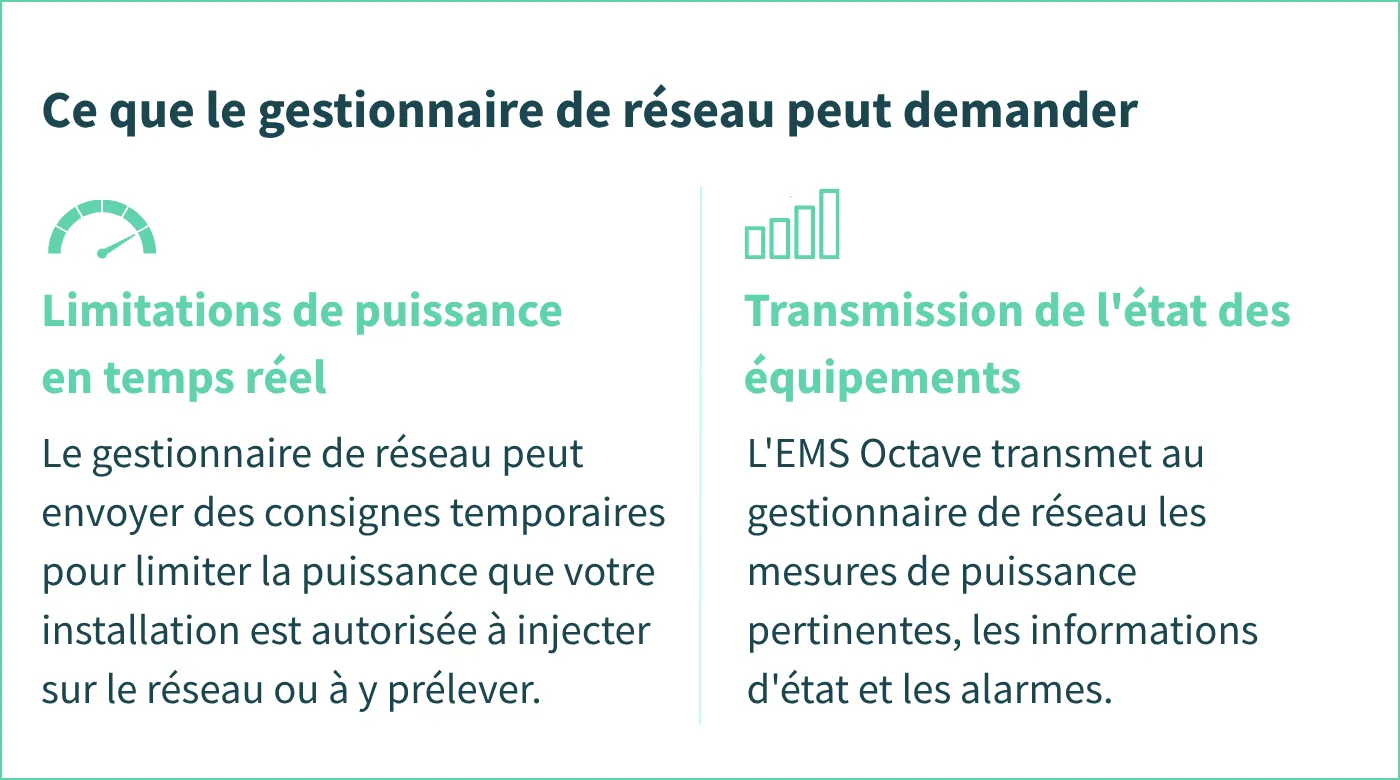
DSO-RTU compliance enables grid operators to remotely monitor and control energy assets such as battery systems and solar installations. Through a standardized communication protocol such as IEC 60870-5-104, the grid operator can send control signals directly to the Energy Management System (EMS).
This allows the grid operator to adjust power in real time when needed to maintain grid stability and prevent local congestion.
For installers and project developers, compliance means that the EMS can receive and execute grid operator commands while reporting relevant measurements and asset status back to the DSO.
Fall-Back Flex
ㅤ
Connect today, in a congestion zone
Grid congestion can delay new or reinforced connections for years. Fall-Back Flex offers an alternative: your installation receives part of its contracted capacity at guaranteed power, while the remaining part is delivered under a flexible scheme that allows the grid operator to ramp it down when the local grid needs it.
When activated, the DSO sends a setpoint to the Octave EMS, which automatically adjusts the installations power sourcing. Once the restriction is lifted, the asset returns to normal operation.
This can enable projects to connect sooner without waiting for major grid reinforcements, while remaining compliant with the grid operator’s requirements.
Three things to remember
01
24/7 possible
Signals can arrive at any moment, but they're reserved for real peaks, plus one unannounced test per year, capped at 30 minutes.
02
You choose how
Shift a process, throttle cooling, cap EV charging, or discharge a battery. The operator sets the limit, never the method.
03
Use your flexibility year-round
Outside the grid operator's activations, you still earn a solid return by steering your assets flexibly across the full range of applications.
One setpoint, one answer
ㅤ
The DSO setpoint always takes absolute priority over the physical, contractual, or other limits already on your connection, the lowest ceiling applies, always, automatically.
The moment a setpoint comes in, the Octave EMS recalculates every connected asset and carries out the adjustment well inside the required reaction window.
A real-world activation example
ㅤ
The site normally draws 600 kW from the grid, while the DSO can guarantee 150 kW of firm capacity. During an activation, the site therefore needs to reduce its grid offtake by 450 kW.
Based on the DSO’s estimated activation schedule, the Octave EMS prepares the site in advance. When the activation starts, flexible loads such as EV charging and cooling are reduced wherever operationally possible. The battery automatically supplies the remaining flexibility needed to stay within the 150 kW limit.
After two hours, the cooling system needs to ramp back up to maintain the required temperature. The Octave EMS automatically adapts its strategy, increasing battery discharge while keeping total grid offtake within the DSO limit.
Talk to us
Got a grid study with DSO-RTU requirements?
We'll walk through the zone-specific requirements together, and show you exactly how the Octave EMS covers them.